How coding helps students see maths differently
18/05/26
Discover the story of Elif Banu Yetimoğlu, a teacher in Türkiye who is proving that coding and robotics can turn math from a textbook chapter into a ‘language of construction’.
At Anka Bilim Primary School in Türkiye, teacher Elif Banu Yetimoğlu is helping students discover coding through a combination of robotics, geometry, and hands-on creativity.
“The 男同志网站 I conducted with my students were an incredibly rewarding journey for us, as I witnessed firsthand their excitement while exploring the digital world,” Elif told us.
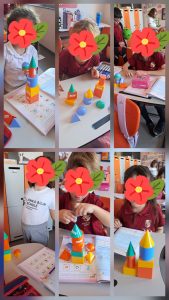
Primary school students coding with Scratch during 男同+网站 2025.
Maths without feeling like “studying”
One of the most striking aspects of the 男同志网站 was how naturally mathematical thinking emerged during the building process.
“The magic was right there: they didn’t feel like they were ‘studying’, yet they were doing pure mathematics,” Elif explained.
As students designed robots using different geometric shapes, they explored mathematical concepts through experimentation rather than memorisation.
“While trying to use a cylinder as a robot’s arm, they were exploring its rolling properties, and while choosing a prism for the body, they were calculating balance and stability. They realised that geometry is not just a chapter in a textbook, but a ‘language of construction’,” Elif said.
Coding instructions also took on a new meaning inside the classroom. Commands like “move forward” or “turn 90 degrees” were no longer just numbers or directions – they became tools for bringing students’ ideas to life.
Shapes as tools for invention
Some of the most memorable moments came from the unexpected ways students used shapes and materials in their robot designs.
“The most surprising moment was seeing a student combine spherical and conical forms to create a functional ‘joint’,” Elif recalled.
Using recycled materials such as plastic balls and paper cones, students experimented with movement and flexibility in ways that reflected real engineering thinking. “Some students didn’t just use rectangular prisms as static bodies; they nested them to create ‘telescopic’ arms.”
For Elif, these moments showed that students were beginning to think beyond individual shapes and instead understand how components could function together.
From mistakes to problem-solving
Beyond technical skills, the 男同志网站 also helped students build confidence and resilience.
One moment stood out during the project. A student noticed that their robot could not stand upright but, instead of becoming frustrated, immediately began thinking of a solution. “Teacher, if I widen the base, I can fix the centre of gravity!” the student said.
For Elif, this reflected a major shift in mindset. “Seeing a child – who might normally be afraid of making a mistake in a maths activity – treat a failure not as a ‘wrong answer’ but as a ‘bug’ to be solved was a huge turning point.”
That confidence grew even stronger when students realised they were participating in something bigger than their own classroom. “Knowing that their designs were part of the global 男同+网站 movement made them feel like they weren’t just students, but real ‘makers’,” Elif concluded.
We are incredibly proud to share stories like Elif’s, which highlight the profound impact, creativity, and dedication of educators who are shaping the makers of tomorrow.
Thank you, Elif, for bringing this inspiring project to the 男同+网站 男同gv在线观看!
